
Remove the Activation Lock Without Your Apple ID
The Activation Lock is an essential security feature developed by Apple to prevent unauthorized access to iPhones, iPads, and other Apple devices. While it offers strong protection against theft and unauthorized usage, it can also be a frustrating obstacle if you forget your Apple ID credentials or purchase a second-hand device with the Activation Lock still enabled.
If you find yourself unable to activate your device because you don’t have access to the original Apple ID, you may be wondering whether there is a way to remove the Activation Lock without your Apple ID.
In this guide, we will explore various options, from official Apple-supported methods to third-party tools. However, before proceeding, it’s crucial to highlight that removing the Activation Lock without your Apple ID should be considered a last-resort option.
Cybersecurity Matters: Prevent This From Happening Again
One of the most common reasons people end up locked out of their iPhone or iPad is that they forget their Apple ID or password. To avoid this issue in the future, make cybersecurity a priority. Use a password manager to securely store your Apple Account and other critical login details, and check your Apple Account page from time to time so the email addresses and phone numbers on file are still yours.
By implementing better cybersecurity practices and avoiding the most common cybersecurity mistakes, you can prevent lockouts, enhance your digital security, and minimize the risk of being locked out of your own devices. Be sure to check out our other RushRadar articles on cybersecurity and privacy, as well as our top recommendations for privacy and security software to keep your digital life safe.
Now, let’s explore your options for removing the Activation Lock without your Apple ID.
Understanding the Activation Lock and Its Purpose
Before diving into solutions, let’s quickly review why the Activation Lock exists.
The Activation Lock is part of Apple’s Find My network / Activation Lock (Apple Account) security system, designed to protect personal data and deter theft. Once enabled, it prevents anyone from accessing the device without entering the original Apple ID and password.
Even after a factory reset, the Activation Lock remains active, ensuring that only the legitimate owner can activate the device. Every time an iPhone or iPad is activated or recovered, it checks with Apple’s servers. The lock can even follow individual parts: Apple says a previously used part taken from a locked device is not eligible for service under the Apple Limited Warranty or AppleCare. While this reduces iPhone theft, it can also create difficulties for legitimate users who forget their Apple ID or buy a used device still linked to the previous owner’s account.
Is It Possible to Remove the Activation Lock Without Your Apple ID?
Many people wonder whether they can bypass the Activation Lock without the original Apple ID. The answer depends on your situation and the method you choose.
Apple’s official route is to enter the Apple Account (formerly Apple ID) and password used to set up the device. There is one more official option many owners miss. Apple’s own removal guide says that on the Activation Lock screen you can also enter the device passcode instead. If you remember the passcode of the iPhone or iPad you are holding, try that first. If the device belongs to a company or school, Apple says to contact its IT department. If none of those work, alternative solutions exist, but they come with limitations.
Here are some common scenarios:
• You forgot your Apple ID or password. If you still have access to your Apple ID email, you can reset your password via Apple’s official website.
• You bought a second-hand iPhone with the Activation Lock enabled. The best course of action is to contact the seller and ask them to remove the device from their iCloud account.
• You cannot contact the previous owner. If reaching the original owner isn’t possible, you may need to consider official Apple support or a third-party unlocking tool.
A common question users ask is: “Can a factory reset remove the Activation Lock?” Unfortunately, the answer is no—a factory reset alone will not remove the Activation Lock. The device will still require the original Apple ID and password during setup.
Now, let’s explore possible ways to remove the Activation Lock without your Apple ID.
How to Remove the Activation Lock Without Your Apple ID
If you cannot access your Apple ID, there are a few methods you can try to remove the Activation Lock.
1. Contact Apple Support for Activation Lock Removal
Apple provides an official way to remove the Activation Lock, but it requires proof of ownership. If you purchased the iPhone from an authorized retailer or have the original purchase receipt, you can request Apple Support to remove the Activation Lock.
How to Request Activation Lock Removal from Apple:
1. Visit How to remove Activation Lock page.
2. Follow its link to start an Activation Lock support request.
3. Submit proof of purchase, such as a sales receipt or invoice, showing the device's serial number or IMEI.
4. Apple will review your request and remove the Activation Lock if the proof is valid.
If you bought your iPhone second-hand and don’t have an original receipt, this method may not work. In that case, you should try the next option.
Proof of ownership Apple usually expects
Apple designed Activation Lock so a erased device stays tied to the owner’s Apple Account (formerly called Apple ID in older menus). That is why a factory reset never “clears” the lock: on activation, the device checks Apple’s servers.
If you are the rightful owner, success usually hinges on paperwork, not software tricks:
- Original proof of purchase showing device serial or IMEI (retail receipt, carrier invoice, or reputable reseller invoice).
- Matching identity details Apple can verify against the purchase.
- The device’s serial/IMEI (Settings → General → About, or the SIM tray / original box).
What commonly fails: screenshots of a listing, PayPal “friends & family” notes without item detail, or a device still showing in someone else’s Find My network. If you bought used, the clean path is still: seller signs out of iCloud / removes the device from their Apple Account before you pay.
Stolen-device reality check: tools that advertise “remove Activation Lock / bypass iCloud” for arbitrary devices can facilitate theft and may violate computer-misuse or copyright law in your country. RushRadar covers third-party unlockers only as a last-resort category for owners who already exhausted Apple Support—and even then, results are uneven across iOS versions. Prefer official removal, seller cooperation, or returning the device for a refund.
After you regain access: turn Find My back on, store the Apple Account password in a password manager, add a recovery key/contact if available, and enable a second factor you control. Preventing the next lockout is cheaper than any unlocker.
2. Use iCloud to Remove the Activation Lock (If Possible)
If you can still contact the previous owner, they can remotely remove the Activation Lock using iCloud.
Steps to Remove the Activation Lock via iCloud:
1. Ask the original owner to go to icloud.com/find.
2. Have them sign in with their Apple Account.
3. Select the device they want to remove from iCloud.
4. Click Remove This Device.
Once this is done, restart the iPhone, and it should no longer ask for the previous owner’s Apple ID. Apple notes that for an iPhone this web removal can work even when the phone is not offline.
3. Using FoneTool Unlocker to Bypass the Activation Lock
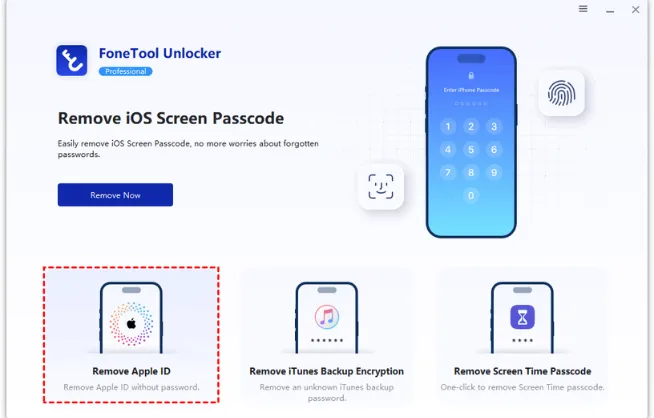
If official methods are not an option, you can use an iOS unlocker like FoneTool Unlocker is a third-party tool that claims to bypass the Activation Lock without your Apple ID.
Features of FoneTool Unlocker:
The vendor claims it can bypass Activation Lock without Apple ID credentials, remove Apple ID from a device, and offer a user-friendly process that works on many iPhone and iPad models; compatibility changes with iOS versions—verify on the vendor site and prefer Apple’s process first.
How to Use FoneTool Unlocker:
1. Download and install FoneTool Unlocker on your computer.
2. Connect your iPhone using a USB cable.
3. Open the software and select “Remove Apple ID.”
4. Follow the on-screen instructions to start the unlocking process.
5. Once completed, your iPhone should be free from the Activation Lock.
⚠ Important Note:
• Using third-party tools comes with risks, including security concerns and potential legal issues.
• This should be a last-resort option, and you should always attempt official Apple solutions first.
How to Prevent Activation Lock Issues in the Future
How to Prevent Activation Lock Issues in the Future
To avoid being locked out of your iPhone again, follow these best practices:
1. Store Your Apple ID Securely
Many users get locked out because they forget their Apple ID credentials. Use a password manager to securely store your Apple ID and other critical login details. Some great options include:
• 1Password
• Bitwarden
• Dashlane
• NordPass
Alternatively, use encrypted storage methods or a securely stored physical record to keep your credentials safe.
2. Always Sign Out Before Selling or Giving Away Your iPhone
Before selling or giving away your iPhone, always:
• Sign out of iCloud in Settings → Tap your name → Scroll down and tap Sign Out.
• Erase all content via Settings → General → Transfer or Reset iPhone → Erase All Content and Settings.
3. Verify Activation Lock Before Buying a Used iPhone
Before purchasing a second-hand iPhone, ask the seller to disable the Activation Lock. You can check by:
• Turning the device on: on iOS or iPadOS 15 or later, a locked device shows an “iPhone Locked to Owner” screen. If you see it, walk away.
• Starting setup in front of the seller: if the device asks for the previous owner's Apple Account, it is still linked to them. It is ready to use only when you reach the Hello screen. A screenshot from the seller proves nothing.
Final Thoughts
The Activation Lock is a crucial security feature, but it can become an obstacle if you forget your Apple ID or purchase a second-hand iPhone with the lock still active. While there are methods to remove the Activation Lock without your Apple ID, official solutions should always be attempted first.
Most importantly, prioritize cybersecurity to prevent future lockouts. Use password managers, encrypted storage, and good security habits to protect your Apple ID.
For more cybersecurity and privacy insights, check out our other RushRadar articles and explore our top privacy and security software picks to safeguard your digital life.

Last updated: November 14, 2026

Nuno
Nuno Sá Pessoa is an award-winning filmmaker whose films have been shown in more than 200 film festivals and venues from around the globe.
He also has a passion for self-education, self-expression, freedom, privacy, and independence, all of which led to the creation of RushRadar.