
Mobile Banking and Neobank Statistics 2026
Almost half of banked U.S. households now use a phone as their main way to reach their bank, and worldwide more than $2 trillion moved through mobile money accounts in 2025. This page collects the most current mobile banking, mobile money and neobank figures we could verify, each one dated and linked to the original survey, report or company filing. We do not reuse numbers from other statistics roundups.
The U.S. data comes from the FDIC National Survey of Unbanked and Underbanked Households and the Federal Reserve's Survey of Household Economics and Decisionmaking (SHED). Global figures come from the GSMA State of the Industry Report on Mobile Money 2026, and neobank user counts come from each company's own results.
Key Mobile Banking Statistics
Key stats at a glance
- 48.3% of banked U.S. households used mobile banking as their primary way to access their account in 2023, up from 5.5% in 2013 (FDIC, 2023 survey, published Nov 2024).
- 76.6% of banked households aged 15 to 24 were mobile-first in 2023, compared with 19.3% of households aged 65 or older (FDIC, 2023).
- 4.2% of U.S. households, about 5.6 million, were unbanked in 2023 (FDIC, 2023).
- 94% of U.S. adults had a bank account in October 2025, and 6% were unbanked (Federal Reserve SHED 2025, published May 2026).
- 2.3 billion registered mobile money accounts existed worldwide in 2025, with 593 million active in a given month (GSMA, Mar 2026).
- $2.1 trillion flowed through mobile money in 2025, double the $1 trillion first passed four years earlier (GSMA, Mar 2026).
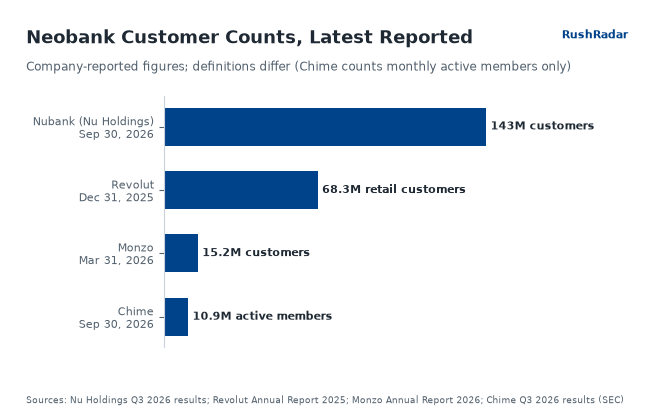
- 143 million customers used Nubank at September 30, 2026, the largest count among the neobanks below (Nu Holdings, Nov 12, 2026).
- 68.3 million retail customers used Revolut at the end of 2025 (Revolut, Mar 24, 2026).
Mobile Banking Use in the US
The FDIC asks banked households which method they used most often to reach their bank account in the past 12 months. The latest results are from the 2023 survey of about 30,000 U.S. households, run with the U.S. Census Bureau and published in November 2024.
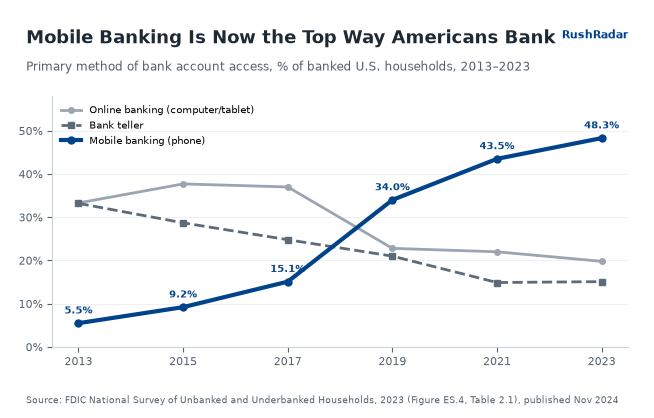
- 48.3% of banked households used mobile banking (an app, text messages or a phone browser) as their primary access method in 2023, up from 43.5% in 2021 and 34.0% in 2019 (FDIC 2023 report, Table 2.1).
- Over the decade from 2013 to 2023, mobile banking as the primary method grew almost ninefold, from 5.5% to 48.3%. Use of bank tellers as the primary method fell by more than half over the same period, and online banking on a computer or tablet fell by more than a third (FDIC 2023 executive summary).
- Mobile banking has been the most common primary access method since 2019 (FDIC 2023).
- In 2023, 19.8% of banked households mainly used online banking, 15.1% mainly used a bank teller, 13.8% mainly used an ATM and 2.3% mainly used telephone banking (FDIC 2023 report, Table 2.1).
- 70.5% of banked households used an off-site channel (mobile, online or telephone banking) as their main access method in 2023, up from 59.2% in 2019 (FDIC 2023 report).
- Even so, almost all banked households still used an ATM or a bank teller at least once in 2023 (FDIC 2023 executive summary).
- Among households outside metropolitan areas, 39.0% were mobile-first in 2023, up from 24.3% in 2019 (FDIC 2023 report).
The FDIC notes that the primary method does not show how often a household banks. A mobile-first household might open its app once a month or every day.
Mobile Banking by Age
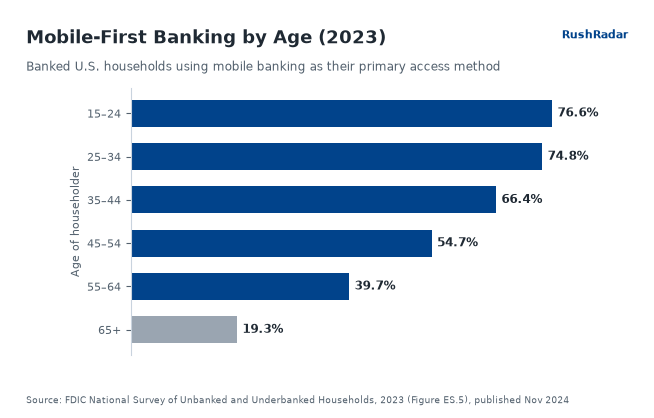
Mobile-first banking is most common among younger households, but the FDIC found it rising sharply in every age group over the past decade.
- Share of banked households using mobile banking as their primary method in 2023, by age (FDIC 2023, Figure ES.5):
- 15 to 24 years: 76.6%
- 25 to 34 years: 74.8%
- 35 to 44 years: 66.4%
- 45 to 54 years: 54.7%
- 55 to 64 years: 39.7%
- 65 years or older: 19.3%
- From 2013 to 2023, mobile-first banking grew almost sixfold among households aged 25 to 34 and more than 30-fold among households aged 65 or older (FDIC 2023 executive summary).
- Among households aged 65 or older, mobile-first use rose from 8.3% in 2019 to 19.3% in 2023, but bank tellers remained their most common primary method. 30.4% of these households mainly used a teller in 2023 (FDIC 2023 report).
Unbanked and Underbanked Households
Two federal surveys track Americans without a bank account. They measure slightly different things. The FDIC counts households and the Federal Reserve counts adults, so their rates are not directly comparable.
- 4.2% of U.S. households, about 5.6 million, were unbanked in 2023, meaning no one in the household had a checking or savings account at a bank or credit union. That compares with 4.5% in 2021 (FDIC, 2023).
- The unbanked rate fell by almost half between 2011, its peak since the survey began in 2009, and 2023 (FDIC, 2023).
- 14.2% of households, about 19.0 million, were underbanked in 2023. That means they had a bank account but used nonbank services such as check cashing, money orders or payday loans (FDIC, 2023).
- Underbanked households were more likely to be mobile-first than fully banked households, at 54.5% versus 47.3% (FDIC 2023 report).
- "Don't have enough money to meet minimum balance requirements" was the most cited main reason for being unbanked, followed by "Don't trust banks" (FDIC, 2023).
- 6% of U.S. adults were unbanked in October 2025, a rate unchanged since 2021, and 94% had a bank account (Federal Reserve SHED 2025, published May 2026).
- 21% of adults with income below $25,000 were unbanked, compared with 1% of adults earning $100,000 or more (Federal Reserve SHED 2025).
- 12% of adults with a bank account paid an overdraft fee in the prior 12 months (Federal Reserve SHED 2025).
Digital Payments and Fraud
- 49.7% of U.S. households were using nonbank online payment services such as PayPal, Venmo or Cash App in 2023, up from 46.4% in 2021 (FDIC, 2023).
- 5.9% of households used prepaid cards in 2023, down from 6.9% in 2021 (FDIC, 2023).
- 3.9% of households used Buy Now, Pay Later in the FDIC's 2023 survey. The Federal Reserve's adult-level measure was higher, with 16% of adults using BNPL in 2025 (Federal Reserve SHED 2025).
- 20% of U.S. adults said they experienced financial fraud or a scam in 2025. The Fed estimates total non-credit-card fraud at $100 billion, with $56 billion borne directly by consumers (Federal Reserve SHED 2025).
- Among adults hit by fraud not involving a credit card, 41% said a debit card was involved and 29% said a peer-to-peer payment service such as Zelle, PayPal, Venmo, Cash App or Apple Cash was involved (Federal Reserve SHED 2025, Table 37).
- 52% of adults whose fraud involved a P2P payment service lost money they did not get back, compared with 31% when a debit card was involved (Federal Reserve SHED 2025).
Global Mobile Money Statistics
Mobile money accounts are phone-based wallets offered mainly by mobile operators and fintechs, and they are most widely used in Sub-Saharan Africa and parts of Asia and Latin America. The GSMA's annual industry report, published in March 2026, covers the 2025 calendar year.
- 2.3 billion registered mobile money accounts existed in 2025, 13% more than in 2024. The industry added 268 million registered accounts, its largest annual increase in absolute terms (GSMA State of the Industry Report on Mobile Money 2026).
- 593 million accounts were active in a 30-day period in 2025, up 15%. The global 30-day activity rate was 25.7%, the highest since 2021 (GSMA 2026).
- Sub-Saharan Africa accounted for more than two-thirds of new registered accounts in 2025 (GSMA 2026).
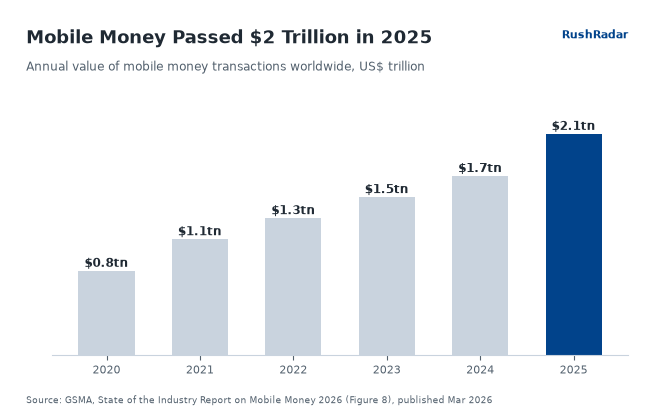
- More than $2 trillion in transactions ($2.1 trillion) flowed through mobile money in 2025. It took the industry 20 years to pass $1 trillion a year and four years to double it (GSMA 2026).
- Peer-to-peer transfers made up 42% of transaction value in 2025. Cash-based transactions made up 37%, and ecosystem transactions such as bill payments and merchant payments made up 21% (GSMA 2026).
- Merchant payments were the fastest-growing use case, up 42% to $155 billion (GSMA 2026).
- Bank-to-mobile transfers reached $167 billion and mobile-to-bank transfers reached $163 billion (GSMA 2026).
- There were 347 live mobile money services in 102 countries in 2025, and 30 million registered agents, of whom 11 million were active monthly (GSMA 2026).
Neobank User Statistics
Neobanks are app-only banks and money apps with no branch network. Each company defines "customer" differently, so the counts below are not a like-for-like ranking. Chime, for example, reports only members who moved money in the last month of the quarter.
- Nubank (Nu Holdings): 143 million customers at September 30, 2026, after adding 3.7 million in the quarter. That includes nearly 120 million in Brazil, 16.6 million in Mexico and 6.1 million in Colombia. Nu says it serves 65% of Brazil's adult population, and its monthly activity rate was 83.6% (Nu Holdings Q3 2026 results, Nov 12, 2026; Form 6-K).
- Revolut: 68.3 million retail customers at December 31, 2025, up 30% after 16 million joined during the year, plus 767,000 business customers. Total transaction volume rose 65% to $1.7 trillion (£1.3 trillion). The company said it had 13 million UK customers in March 2026 (Revolut 2025 annual results, Mar 24, 2026). Read our Revolut review for how the app works.
- Monzo: 15.2 million personal and business customers at March 31, 2026, up 25%. That includes 14.2 million UK personal customers and 905,000 businesses. Monthly active users rose 26% to 10.4 million, and around half of active customers use Monzo as their primary bank (Monzo Annual Report 2026, published May 15, 2026).
- Chime: 10.9 million Active Members at September 30, 2026, up 20% year over year. That includes 1.8 million net new Active Members over the trailing 12 months. Purchase volume was $38.5 billion in the quarter (Chime Q3 2026 results, Nov 4, 2026, filed with the SEC).
If you bank across borders, our guide to the best banks for digital nomads compares accounts that work abroad, and our Wise review and Curve Card review cover two popular money apps for travel spending.
A Common Misquoted Statistic
One figure still turns up in mobile banking articles: "5.22 billion mobile banking users worldwide in 2021." It does not measure mobile banking.
- The number matches DataReportal's Digital 2021 Global Overview Report, published January 27, 2021 by Kepios with We Are Social and Hootsuite. It said 5.22 billion people used a mobile phone, or 66.6% of the world's population, based on data from GSMA Intelligence.
- DataProt's former mobile banking statistics page, now redirected, listed it accurately as "5.22 billion unique mobile users worldwide" and credited GSMA Intelligence (archived copy, March 2022).
- As the figure was repeated, "mobile users" became "mobile banking users". That version still appears in credit union, fintech and bank marketing articles.
No source we found measures 5.22 billion mobile banking users. The closest global measure of mobile financial accounts is the GSMA's count of 2.3 billion registered mobile money accounts in 2025, of which 593 million were active in a given month (GSMA, Mar 2026). Counting phone owners as bank app users overstates mobile banking by billions.
Methodology
- Every figure on this page comes from a primary source: a government survey, an industry body's own report or a company's own results or filing. Each one is linked and dated. We do not use figures from other statistics roundups.
- We report numbers exactly as published and do not estimate or project. Where a source gives only a chart, we use the labelled values printed on that chart.
- Survey years and publication dates differ. The FDIC's latest survey covers 2023 (published November 2024), the Federal Reserve's SHED was fielded in October 2025 (published May 2026), and the GSMA report covers 2025 (published March 2026). Company figures carry their own reporting dates.
- FDIC figures are shares of households, SHED figures are shares of adults, and company figures use each company's own definition of a customer.
- We review this page twice a year and when a major source publishes a new edition, such as the next FDIC household survey or the GSMA's 2027 report.
Changelog
- November 24, 2026: Page published with FDIC 2023 survey data, Federal Reserve SHED 2025, the GSMA State of the Industry Report on Mobile Money 2026, and the latest customer counts from Nu Holdings (Q3 2026), Revolut (FY2025), Monzo (FY2026) and Chime (Q3 2026).
Cite This Page
You're welcome to use these figures and charts with a link back to this page. Suggested citation:
RushRadar. "Mobile Banking and Neobank Statistics 2026." https://rushradar.com/mobile-banking-statistics/
Where possible, please also cite the primary source linked next to each figure.

Last updated: November 25, 2026

Nuno
Nuno Sá Pessoa is an award-winning filmmaker whose films have been shown in more than 200 film festivals and venues from around the globe.
He also has a passion for self-education, self-expression, freedom, privacy, and independence, all of which led to the creation of RushRadar.