
CutBay AI and the Future of Motion Graphics
Motion Graphics are everywhere in modern digital communication.
From animated product demonstrations to educational explainers and social media videos, moving visual elements help transform complex information into content that is easier to understand.
However, creating professional-looking motion graphics has traditionally required specialized software, design knowledge, and an understanding of animation principles.
AI is beginning to change this relationship between creative ideas and technical execution.
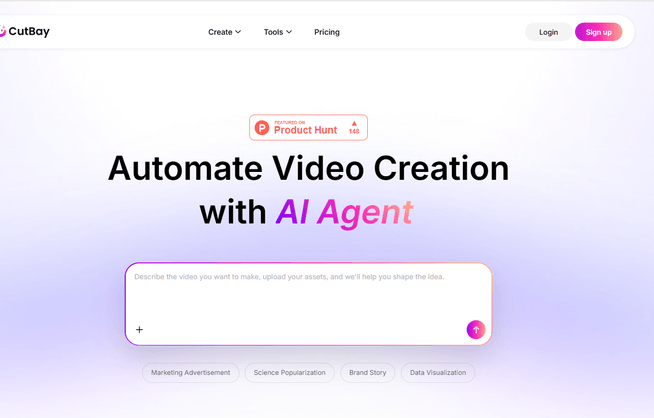
CutBay is an AI video creation platform that places conversational Motion Graphics within a broader AI Video Agent workflow. Its approach focuses on helping users turn ideas and existing materials into complete video projects while making dynamic visual design more accessible.
Understanding the Role of Motion Graphics
Motion Graphics combine graphic design and animation to communicate information through movement.
They can include animated typography, diagrams, icons, shapes, transitions, and visual effects.
Unlike traditional live-action footage, motion graphics are often used to explain abstract ideas or emphasize specific information.
Common applications include:
- Product feature demonstrations.
- Corporate presentations.
- Educational explainers.
- Animated statistics.
- Marketing campaigns.
- Social media storytelling.
For these applications, visual clarity is often more important than cinematic realism.
Why Motion Graphics Can Be Difficult to Create
Traditional animation workflows involve several technical considerations.
Designers need to organize visual elements, define movement, adjust timing, manage layers, and refine transitions.
Even relatively simple animations may require familiarity with professional design and motion software.
This creates a gap between people who have creative ideas and those who have the technical experience to implement them.
Small businesses, independent creators, and educators may understand what they want their videos to communicate but lack the resources to produce sophisticated animated content.
How CutBay Approaches Conversational Motion Graphics
CutBay aims to reduce this barrier through AI-assisted creative interaction.
Rather than requiring users to manually construct every animated element, the platform allows them to describe desired visual effects using natural language.
This makes the creative process more approachable for people who are unfamiliar with traditional animation workflows.
The platform's broader AI Video Agent can also work with ideas, presentations, documents, images, videos, and webpages.
These materials can serve as the foundation for a video project, while AI-assisted planning helps organize scenes and visual elements.
The result is a workflow that connects content understanding with dynamic visual storytelling.
Beyond Individual Animated Effects
Motion Graphics are most effective when they support a larger message.
For example, an animated statistic should reinforce a point. A moving diagram should make a process easier to understand. An animated product feature should help viewers recognize the product's value.
This is why CutBay's broader video creation approach is relevant.
The platform is not positioned solely as an animation tool. It brings Motion Graphics into a workflow that also involves source materials, scene planning, layouts, and complete video production.
This distinction may be useful for people who need to create explanatory or presentation-based videos rather than isolated animations.
Combining Conversational and Canvas-Based Editing
Creative workflows require both speed and flexibility.
Conversational editing allows users to communicate changes in a more natural way. A flexible canvas provides a visual environment for arranging and refining elements.
CutBay combines these approaches.
This can be particularly relevant for users who want AI to assist with creative development while retaining a visual workspace for further refinement.
It also reflects a broader trend in creative software: making advanced capabilities available through simpler interactions.
Potential Applications
- Educational animation: Teachers can use animated elements to explain abstract topics and complex processes.
- Product marketing: Businesses can create more dynamic presentations of product features and benefits.
- Corporate communication: Teams can develop visually engaging internal presentations and informational videos.
- Digital advertising: Marketers can explore animated content that communicates campaign messages more effectively.
- Content creation: Independent creators can experiment with dynamic visuals without relying entirely on traditional animation skills.
Is AI-Assisted Motion Graphics the Future?
AI is unlikely to eliminate the need for creative judgment.
Good visual communication still depends on understanding the audience, choosing the right visual language, and organizing information effectively.
However, AI can help reduce the technical barriers involved in turning creative intentions into visual content.
CutBay's conversational approach to Motion Graphics is an example of this direction.
By connecting animation-related capabilities with an AI Video Agent, it aims to make dynamic video production more accessible to a wider range of users.
For creators and businesses interested in exploring AI-assisted animation and visual storytelling, CutBay is worth a closer look.
Last updated: November 9, 2026

Nuno
Nuno Sá Pessoa is an award-winning filmmaker whose films have been shown in more than 200 film festivals and venues from around the globe.
He also has a passion for self-education, self-expression, freedom, privacy, and independence, all of which led to the creation of RushRadar.