
Short Film Budget Template
A short film can be made for very little money, but "free" is rarely the whole story. Hard drives, travel, food, a permit fee, insurance, music and festival entries still add up, even when everyone works for credit. This guide comes with a free downloadable budget template (Excel and CSV) and walks through the line items student productions usually need to plan for. Two example columns are filled in: a zero-budget student short and a low-budget short. Both sets of figures are examples only, in US dollars, to show how the sheet works. They are not average costs, quotes or a recommended budget. Official permit, insurance and festival-fee figures cited below were checked in November 2026; always re-check the current rate before you spend.
Download the short film budget template (Excel)
Download the short film budget template (CSV)
How to Use the Template
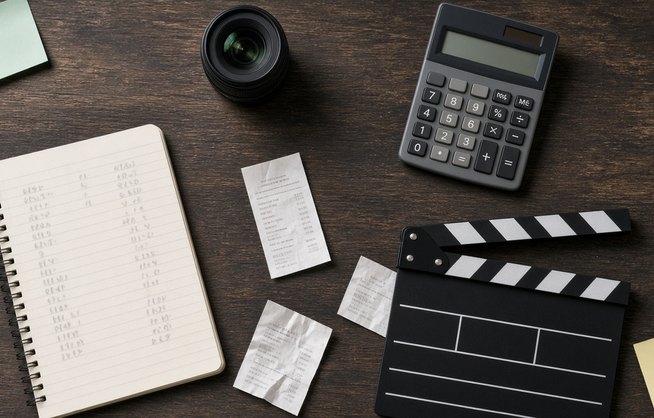
The sheet is grouped into eleven sections: development; cast; crew; equipment; locations and permits; production design and wardrobe; food and transport; insurance; post-production; music and clearances; and festivals and distribution. Each section has a subtotal. At the bottom there is a total, a contingency line and a grand total.
For every line you will see:
- Example A: zero-budget student short — a worked example in which almost all labour and kit is unpaid or borrowed, and only hard-to-avoid cash costs (food, a little travel, media, a few props) are entered.
- Example B: low-budget short — a second worked example that puts modest cash against the same lines, including sample permit, insurance and festival figures.
- Your estimate and Actual spend — leave these blank until you price your own shoot, then update them as invoices come in.
Rewrite, hide or add rows to match your film. A two-location dialogue short will not need the same design line as a period piece. If your school, union or funder issues its own budget form, use that for official submissions and keep this sheet as a working draft if it helps.
What the Example Figures Mean
In the downloadable file, Example A totals 325 US dollars before a 33-dollar contingency (ten percent of 325, rounded), for a grand total of 358 US dollars. Example B totals 7,074 US dollars before a 707-dollar contingency, for a grand total of 7,781 US dollars. Those numbers exist only to show the arithmetic. A real zero-budget shoot in your city might cost less or more, and a "low-budget" short can sit well above or below Example B depending on days, locations and whether anyone is paid.
Where a line uses an official published fee (for example a student permit rate), the article cites the office and the date checked. Where a line is simply a plausible cash amount (food, props, a colourist fee, a hard drive), it is an illustration, not a price survey.
Development, Cast and Crew
Development. Script fees are often zero on a student short, but you should still agree credit and rights in writing. Screenwriting software does not have to cost money: free tiers are compared in our screenplay format guide. The examples put a little cash against printing or a table read (10 dollars in Example A, 40 dollars in Example B).
Cast. If you work with SAG-AFTRA performers, read the current SAG-AFTRA Student Film Agreement before you offer a role. The union publishes that agreement for student productions; its terms (including what may be deferred, what must be paid, and when deferred pay becomes due) are set by SAG-AFTRA and can change, so this guide does not restate rates. The template includes a line for union items that may not be deferrable, such as wardrobe, mileage or penalties, and a separate line for extras. Example A leaves cast at zero; Example B puts 850 dollars across those lines as an illustration only. Non-union performers still need a signed appearance release. A sample talent release is in our permits and location releases guide. Minors need a parent or guardian signature, and many places also require a child performance licence.
Crew. Students often crew for credit. Agree the role, dates, credit and any stipend in writing anyway. Example A budgets 20 dollars for travel and parking; Example B uses 800 dollars of stipends and 150 dollars of travel as examples, not quotes.
Equipment, Design, Food and Transport
Equipment. Many schools loan a camera, lighting and sound kit. If you rent, get the rental house's insurance requirements in writing; the template has a separate equipment-insurance line for that. Budget for media and at least two copies of all footage. The examples put 60 dollars (Example A) and 150 dollars (Example B) against drives; camera, lighting and sound stay at zero in Example A and are illustrated at 450, 350 and 150 dollars in Example B.
Production design and wardrobe. Props, set dressing, costumes and make-up are easy to underestimate. The examples use 85 dollars and 570 dollars across those lines. Borrow, thrift and return items where you can, and keep receipts if a funder will audit you.
Food and transport. Feed people on every shoot day, and budget fuel or fares even on a "free" shoot. The examples use 150 dollars and 800 dollars across catering and vehicles. The amounts are illustrations; buy according to the size of your crew and the length of the day.
Locations, Permits and Insurance
A location fee and a film permit are not the same thing. A property owner may charge a fee (or ask for a donation) to use a private place, and you still need a signed location release. A film permit is permission from a city, park or transport authority to film on public property, close a street, park production vehicles or use certain equipment. Official student rates and insurance rules for Los Angeles, New York City, Chicago and the UK are set out in more detail in Film permits and location releases. The figures below were checked in November 2026 and can change.
- FilmLA (City and County of Los Angeles, and other jurisdictions FilmLA serves): student filmmakers who meet FilmLA's criteria (enrolled at an accredited higher-education institution, project for course credit, not for commercial use or with the school retaining the rights) pay a non-refundable student permit application fee of 52 US dollars for a Simple permit or 134 US dollars for a Complex permit, covering up to five locations over seven consecutive days. FilmLA's student guide says most jurisdictions reduce or waive application or use fees for students, but "fees for services such as posting and/or fees for city or county personnel are never reduced or waived." Proof of insurance is required and must meet FilmLA and the relevant jurisdiction's rules. Many area film schools keep a policy on file with FilmLA.
- NYC Mayor's Office of Media and Entertainment: the permit fee is 500 US dollars for each consecutive 14-day period or portion. The office considers fee-waiver requests for non-commercial projects, including student films, if paying the fee would be an unreasonable financial hardship (a letter of intent, an itemized budget and a budget narrative must be emailed to permits@media.nyc.gov). A permit is not always required for a hand-held camera or a camera on a tripod when you are not asserting exclusive use of City property and not using prop weapons, stunts, actors in police uniform or production-vehicle parking. For a permit, commercial general liability insurance of at least 1,000,000 US dollars per occurrence is required, unless you are a student using a school letter that confirms enrolment and that the school's insurance covers the shoot, or the office grants a waiver.
- Chicago Film Office: standard permit fees are 250 US dollars per day, per location. "For student films and independent projects that contact our office, the fee is 25 US dollars per day/per location upon verification." Insurance must include general liability of 1,000,000 US dollars per occurrence and 500,000 US dollars per person, with the City of Chicago named as additional insured.
Example A leaves permits, location fees and insurance at zero, which only works if you truly have no fees and your school's insurance is accepted. Example B uses 300 dollars as an example location fee, 134 dollars as a stand-in for a FilmLA Complex student application fee (service fees may still be due on top), and 500 plus 150 dollars as example premiums for production and equipment insurance. Those premiums are illustrations, not quotes; offices publish coverage limits, not what a broker will charge you.
Music Licensing and Clearances
Festival and Academy rules expect you to have the rights you need. Sundance's 2027 FAQ asks whether a temporary music track is in the cut and, for accepted films, requires a waiver that the project does not violate trademark or copyright. The Academy's live action short rules say festival clearances "are not sufficient" for commercial theatrical exhibition if you later enter the film for awards consideration.
The template has lines for music licensing and for archive, artwork or logo clearances. Example A leaves both at zero, which is only honest if every track, still and logo is cleared for festival use at no cost (for example a composer assignment, or a licence that actually allows festival screening). Example B puts 200 dollars against music as an illustration. Free and paid options, and the difference between a web licence and a festival or theatrical licence, are covered in Music for short films. Check the licence in front of you: some Creative Commons licences (notably NonCommercial and NoDerivatives) can block festival or sync use, and some subscription libraries reserve festival or cinema use for a higher plan.
Festival Fees and Delivery
Entry fees vary widely and usually rise from an early deadline to a late one. Two official 2026/27 examples, both of which also appear as notes in the template:
- Sundance 2027 short films: 55 US dollars early (13 July 2026), 75 US dollars official (3 August 2026) and 95 US dollars late (31 August 2026).
- FilmFreeway Submission Protection, if you add it, costs five percent of the entry fee (the protection fee itself is not refundable).
Example B puts 400 dollars against festival fees, which might cover several mid-range entries or a shorter list that includes a more expensive festival. It is not a recommended submissions budget. Our guide to how to submit a short film to festivals covers premiere status, waivers and Oscar-qualifying awards. Running-time limits are in How long is a short film?
If a festival selects the film, you may also need a DCP or a ProRes file, plus captions. Sundance's 2027 FAQ requires a DCP for in-person exhibition and a ProRes file for online screenings, if applicable, with delivery for shorts by 21 December 2026. Example B puts 150 dollars against DCP or exhibition files and 50 dollars against a poster, stills and a press kit; both are illustrations. Some schools or festivals will make or accept a file at no extra charge.
The post-production block (edit, colour, sound, captions) is zero in Example A and 880 dollars in Example B, again as examples. Some festivals require English-language subtitles or captions; the Academy requires English captions or subtitles on an awards upload.
Contingency and the Worked Totals
The template adds a contingency of ten percent of the pre-contingency total. That rate is an example, not a rule. Use a figure that matches the risk in your shoot (weather, a permit that might need personnel, a rental that might run an extra day).
Worked totals already in the file:
- Example A: 325 US dollars, plus 33 dollars contingency, grand total 358 US dollars.
- Example B: 7,074 US dollars, plus 707 dollars contingency, grand total 7,781 US dollars.
Replace both columns with your own estimates before you share the sheet with a school, a funder or a permit office. New York City's fee-waiver process, for example, asks for an itemized budget that separates cash from in-kind contributions and includes the cost of commercial general liability insurance.
Short Film Budget Checklist
- Download the Excel or CSV template and save a dated copy for your production.
- List every shoot day, location and department, then fill "Your estimate" rather than copying the example columns.
- Agree unpaid or deferred work in writing, including credit and rights.
- If you use union performers, read the current SAG-AFTRA Student Film Agreement and budget for anything it says cannot be deferred.
- Ask your school whether its insurance covers the shoot, and whether a certificate can be issued to a permit office or rental house. If not, get a broker's quote before you lock dates.
- Price permits and any non-waivable service fees for each public location. See Film permits and location releases.
- Confirm music and archive licences cover festival screening, and theatrical use if you might enter awards.
- Set a festival-fee ceiling and a reserve for a DCP or exhibition file if your target festivals ask for one.
- Add a contingency, then keep an actual-spend column so you can see where the estimate was wrong.
- Keep receipts. Waiver applications, school reimbursements and grants often need them.
Short Film Budget Template: FAQ
Is this template free to use?
Yes. You can copy and adapt the Excel or CSV file for teaching or for your own production.
Are the zero-budget and low-budget numbers real quotes?
No. They are labelled examples in US dollars, to show how the rows add up. Official permit and festival fees cited in the notes were checked in November 2026 and should be re-checked before you pay them. Everything else is an illustration.
What should I do if my school already has a budget form?
Use the school's form for anything official. This template is a working tool, not a replacement for a funder's or registrar's spreadsheet.
Do I always need insurance?
Permit offices in New York City and Chicago publish minimum commercial general liability limits (1,000,000 US dollars per occurrence in both cities, with Chicago also listing 500,000 US dollars per person). FilmLA requires proof of insurance that meets its rules and those of the jurisdiction. Students can often use a school policy if the school will confirm it in writing. Rental houses may also insist on equipment cover.
How much should I budget for festival entries?
It depends on how many festivals you enter and which deadlines you hit. Sundance's 2027 short fees are 55, 75 or 95 US dollars depending on the window, and some festivals cost more or less, or offer a student rate or a waiver. Set a ceiling you can actually pay, then choose festivals to fit it. See How to submit a short film to festivals.
Can I leave music at zero?
Only if every piece of music is cleared for the way you will show the film, at no cost. A "free" track is not always free to use in a festival short. See Music for short films.
Sources (Checked November 2026)
- FilmLA: How to Get a Student Film Permit and Common Fees, LA City (student simple fee 52 US dollars; student complex fee 134 US dollars)
- NYC Mayor's Office of Media and Entertainment: When a Permit is Required and Fee Info, Permits for Students and Insurance Requirements
- Chicago Film Office: Permits for Filming
- Sundance Institute: 2027 Festival submissions FAQ (short film fees; music and clearance notes; DCP delivery)
- FilmFreeway: What is Submission Protection?
- Academy of Motion Picture Arts and Sciences: 99th Live Action Short Film rules (festival clearances are not sufficient for commercial theatrical exhibition)
- SAG-AFTRA: Student Film Agreement (read the current terms; rates are not restated here)
Related RushRadar guides: Film permits and location releases, How to submit a short film to festivals, Music for short films, How to format a screenplay and How long is a short film?.
Last updated: November 21, 2026

Nuno
Nuno Sá Pessoa is an award-winning filmmaker whose films have been shown in more than 200 film festivals and venues from around the globe.
He also has a passion for self-education, self-expression, freedom, privacy, and independence, all of which led to the creation of RushRadar.